
HubSpot integration
Last updated April 2026
Workspace integration — no extra HubSpot seats required
The HubSpot integration is set up once per workspace by an admin. Every Roadmappy user in your company can then search, chat with, and build reports against the synced CRM data.
Overview
Connecting HubSpot lets Roadmappy ingest your CRM records and customer-facing engagements and make them searchable, chat-queryable, and available to reports. Roadmappy only reads from HubSpot — it never writes, never replies, never modifies your data.
What syncs from HubSpot
| Object | What it includes |
|---|---|
| Contacts | Name, email, job title, lifecycle stage, company affiliation |
| Companies | Name, industry, employee count, annual revenue, lifecycle stage |
| Deals | Amount, stage, pipeline, close date, owner |
| Tickets | Subject, content, priority, pipeline stage |
| Calls | Recording / transcript, duration, status, associated contacts and companies |
| Emails | Subject, body, from / to, direction, associated contacts and companies |
| Meetings | Title, body, start / end time, outcome, associated contacts and companies |
| Notes | Body and associated contacts, companies, and deals |
| Owners | Name and email of the HubSpot user behind each record |
On first connection, Roadmappy backfills your CRM history in three phases:
- CRM objects (contacts, companies, deals, owners) — full historical sync, no cap.
- Engagements (calls, emails, meetings, notes) — most recent 2,500 per type.
- Tickets — most recent 5,000 records.
After the backfill, incremental syncs pick up new and updated records automatically.
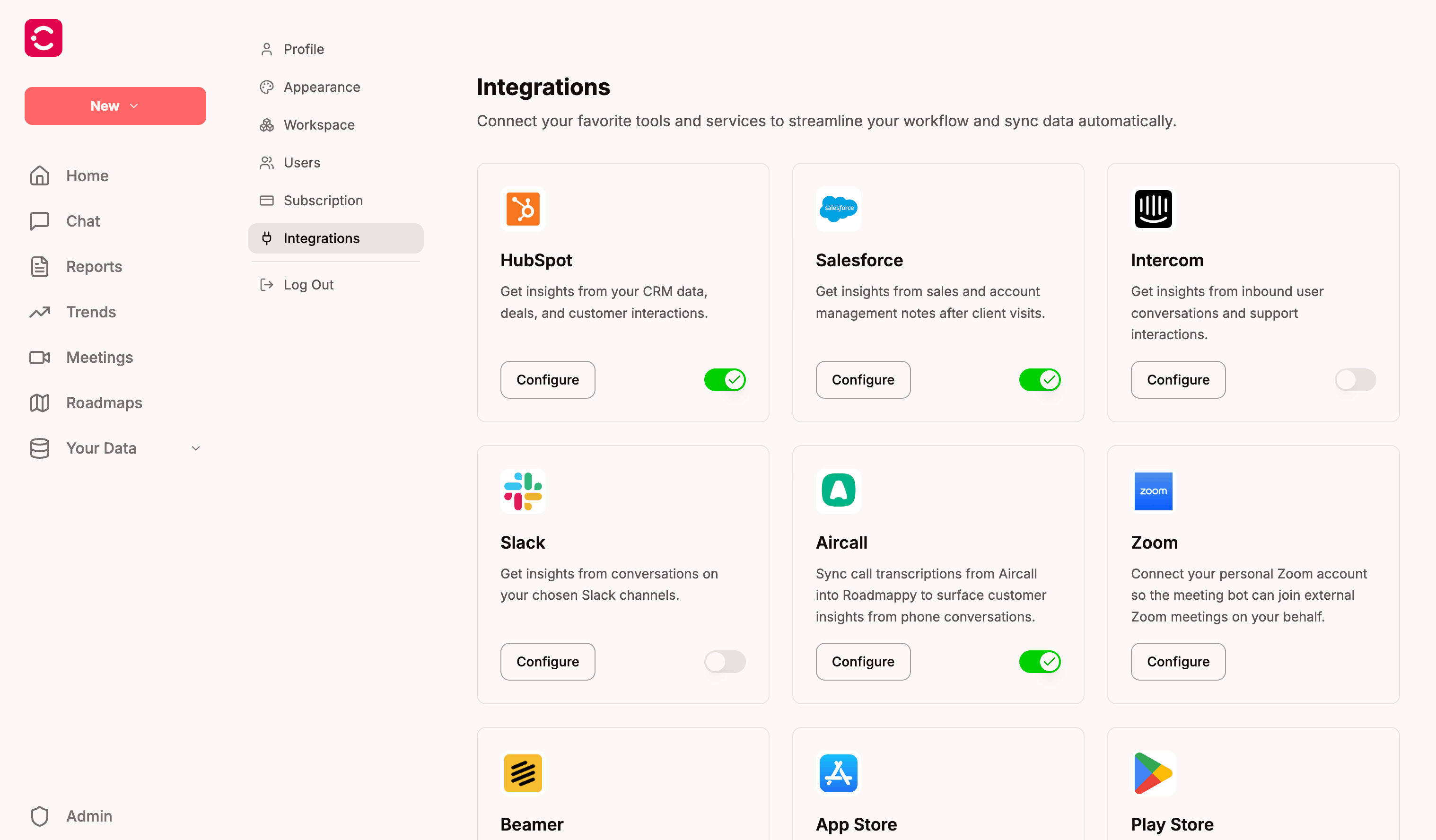
Step 1 — Open the HubSpot integration card
Go to Settings → Integrations. Find the HubSpot card and click Configure.
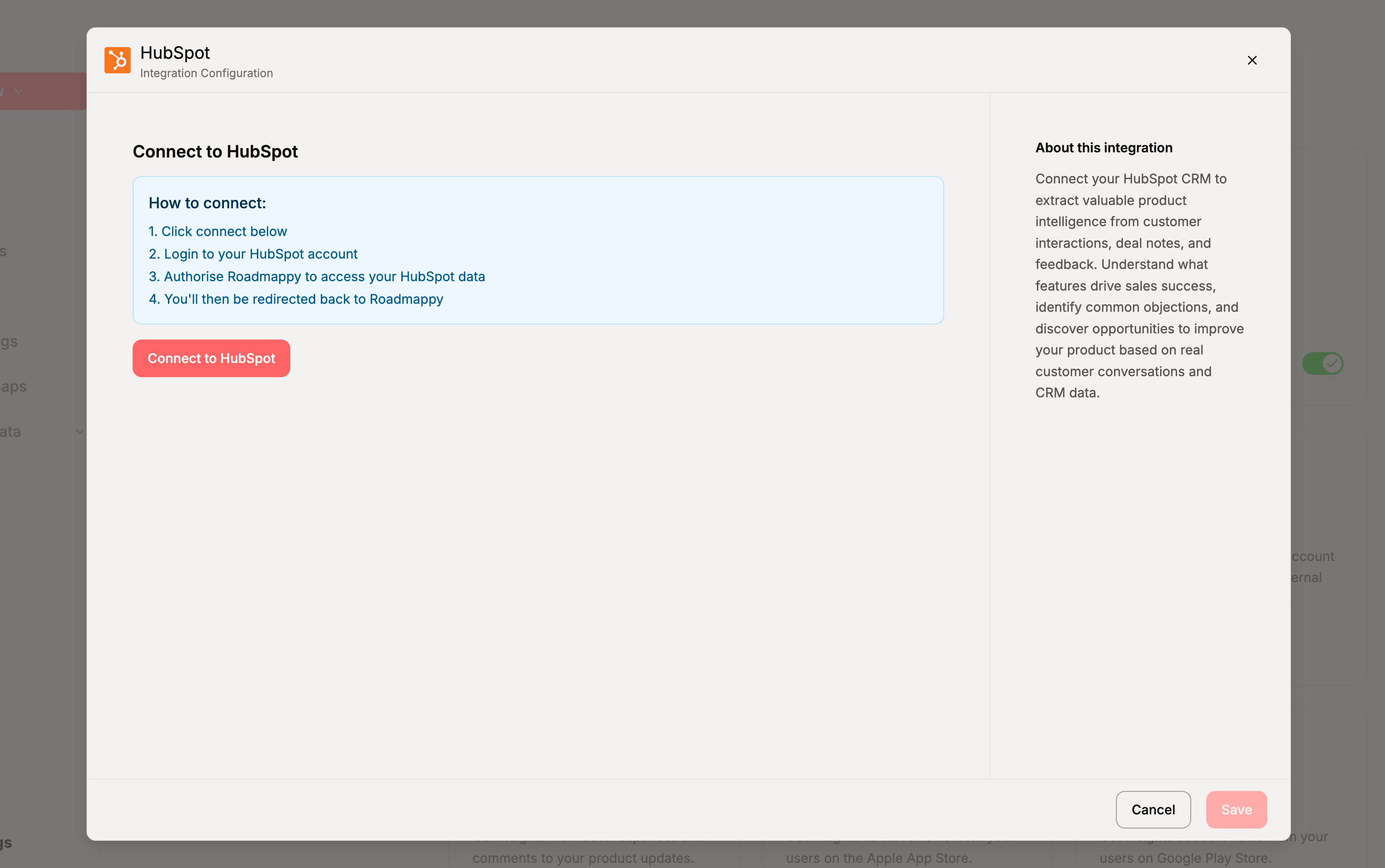
Step 2 — Connect your HubSpot workspace
The HubSpot integration modal opens with a short four-step primer and a Connect to HubSpot button. Click the button to begin the OAuth flow — you will be redirected to HubSpot.
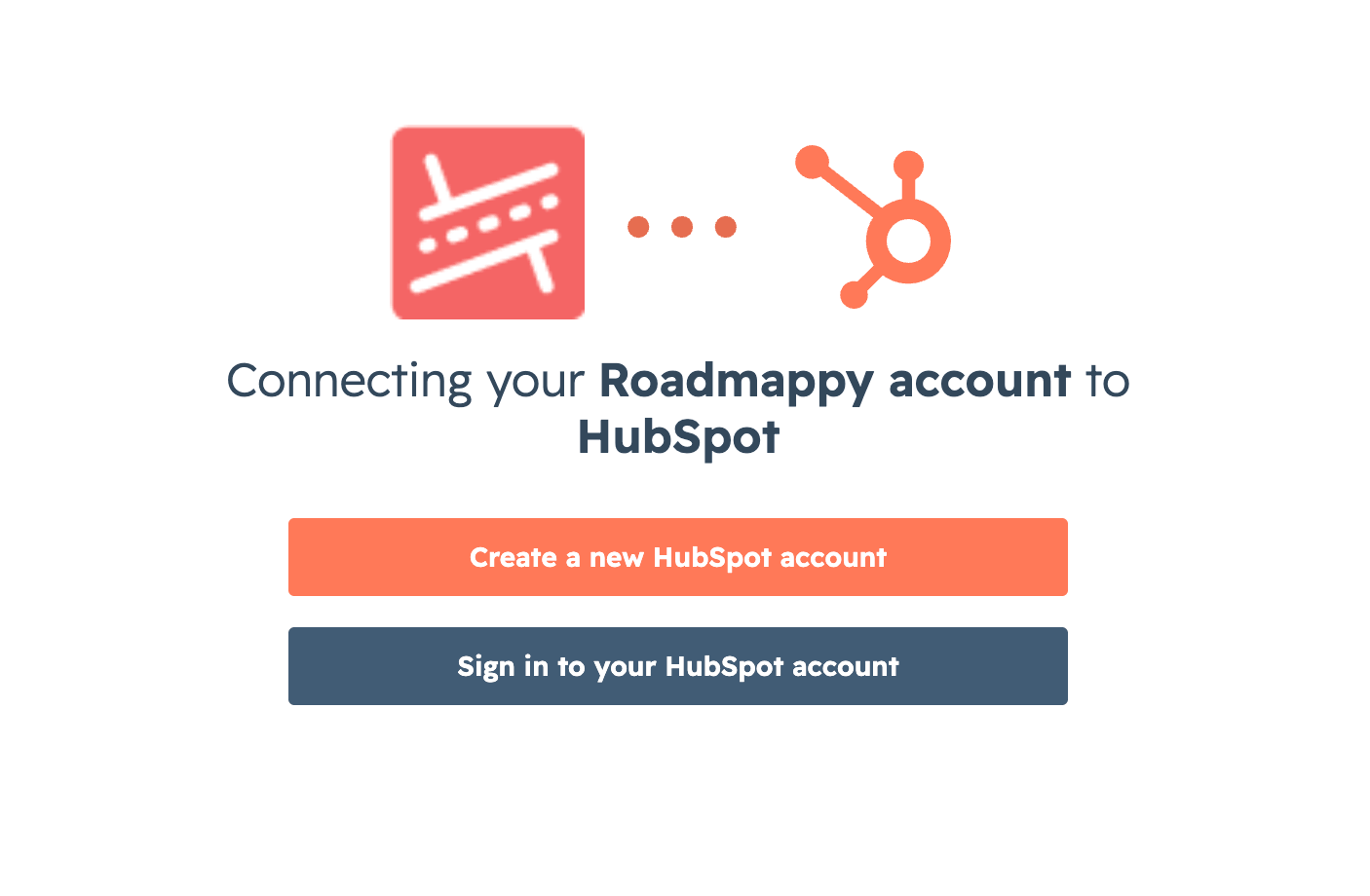
Step 3 — Approve HubSpot permissions
HubSpot opens a consent screen for Roadmappy. Sign in to the HubSpot account you want to connect (or create a new one), then authorise Roadmappy to read data from that account. Roadmappy requests only the read-only scopes needed to ingest CRM records and engagements with full author information — no write access to anything in your HubSpot account.
Step 4 — Confirm the connection
After approving, you are returned to Roadmappy. The HubSpot card on the Integrations page now shows as Connected with an Active toggle. The initial backfill begins in the background — CRM objects sync immediately, with engagements and tickets following about 15 minutes later. Depending on the size of your HubSpot account, the full backfill can take a few hours to complete.
Using HubSpot in Roadmappy AI Chat
Once HubSpot is connected and the initial sync has run, your CRM records and engagements become part of the data Roadmappy AI Chat can query. When you ask Chat something like:
- "What are enterprise prospects asking about in sales calls this month?"
- "Summarise the open tickets for Acme Corp."
- "Which deals mention the new billing flow?"
…Roadmappy AI reaches into your HubSpot history, pulls the most relevant contacts, deals, and engagements, and cites them directly. In the example below, Chat prepares for a meeting with Cormorant Bikes — pulling the account overview, primary contacts, annual revenue, and active opportunities from HubSpot, each point footnoted with the exact record it came from.
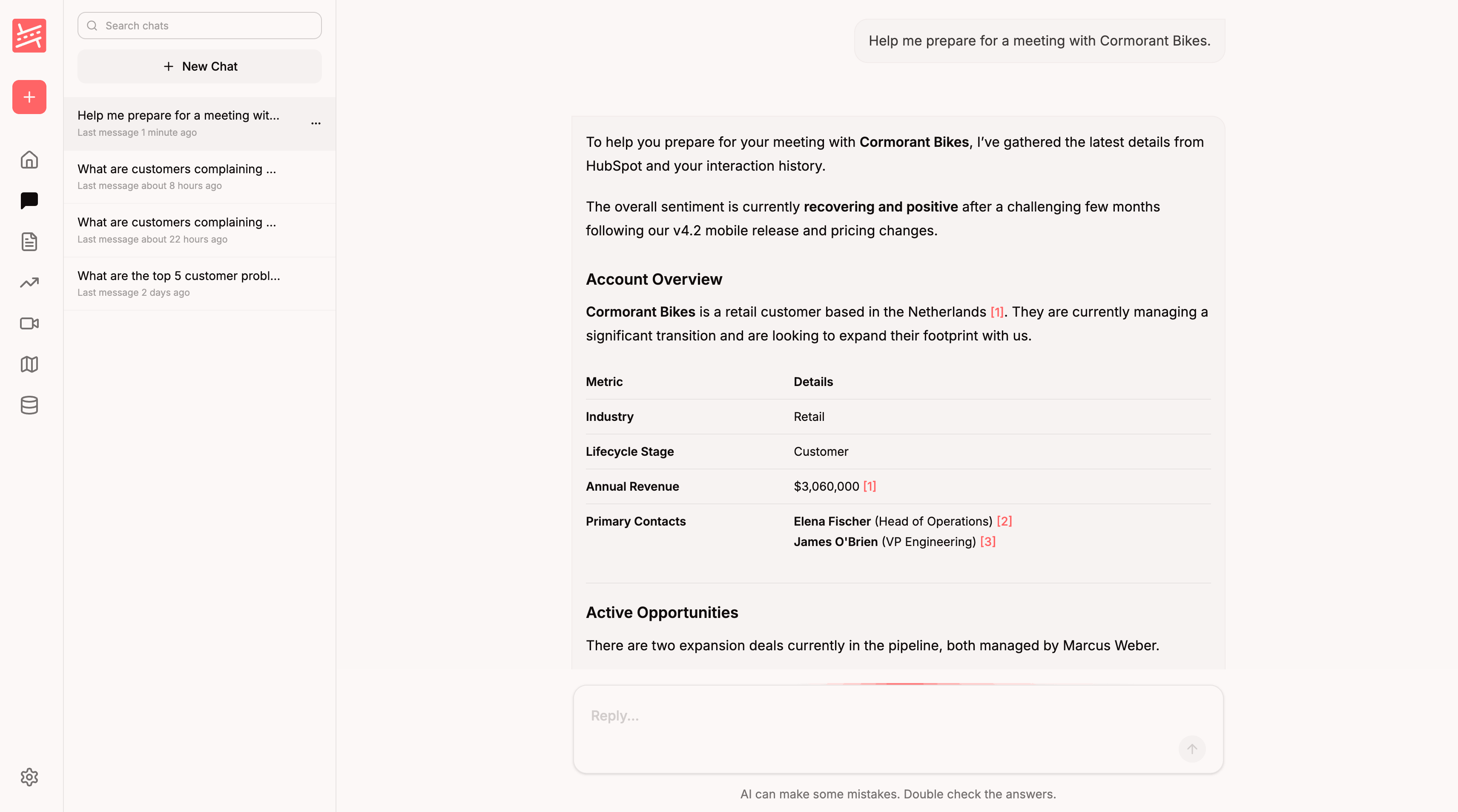
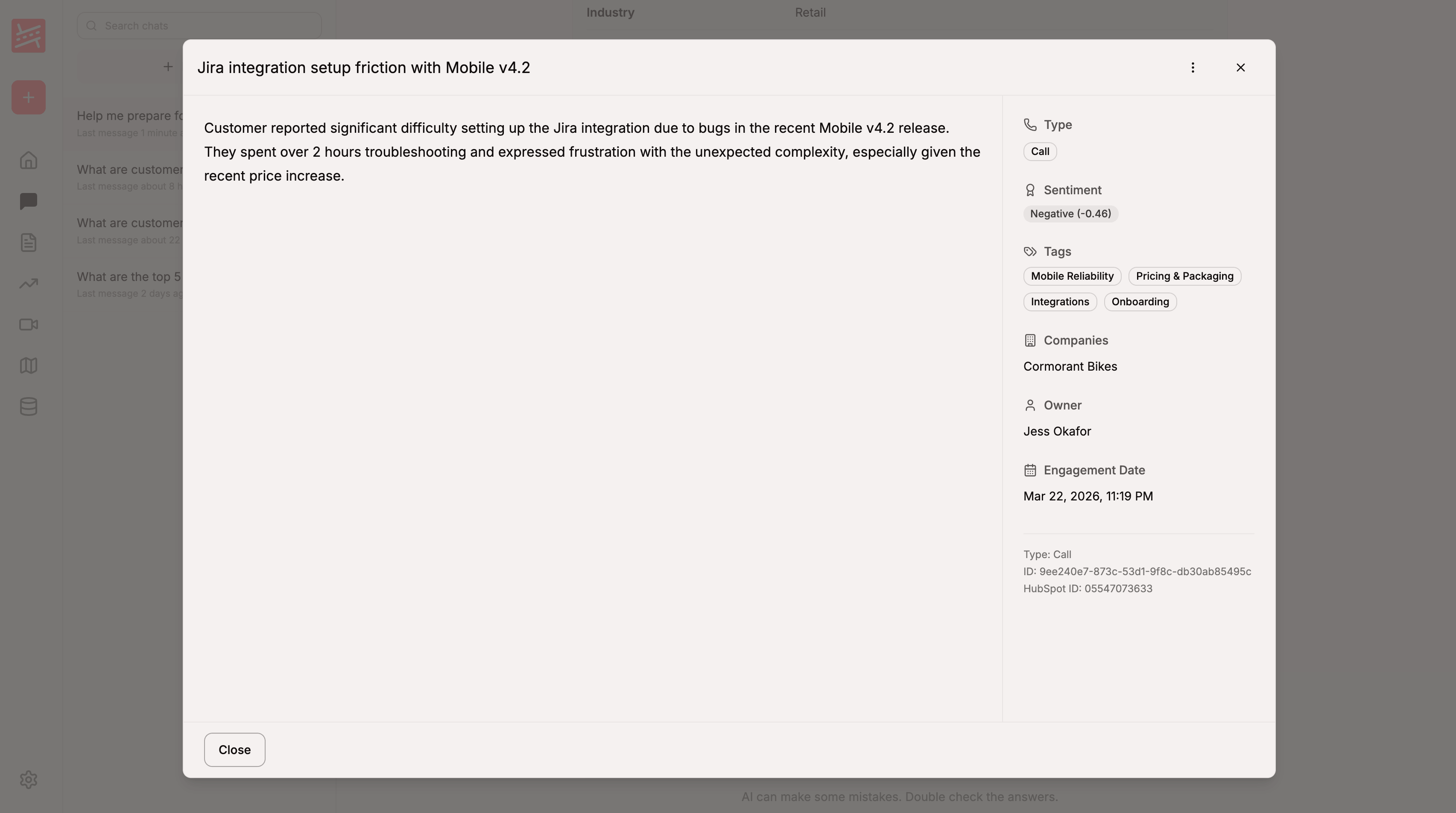
Clicking any numbered citation opens the underlying engagement or CRM object in Roadmappy so you can read the original content, see who was involved, check the associated company and owner, and jump to the record in HubSpot if you need more context.
Chat respects the same permissions as the rest of Roadmappy — only users with access to your workspace can query HubSpot data, and admins can revoke the integration at any time.
Using HubSpot in Reports
HubSpot data also feeds into Reports — the scheduled, Roadmappy AI-authored summaries that land in your inbox or Slack. Reports pull from every connected source (meetings, HubSpot, Intercom, Salesforce, Slack, Aircall) to produce a unified view.
Common ways to use HubSpot in reports:
- Weekly sales pulse — top objections from sales calls, deals at risk by stage, sentiment trend across customer-facing engagements.
- Feature feedback — filter the corpus by a product theme and summarise what customers said about it across calls, emails, meetings, and notes.
- Account digest — surface the full activity timeline for a specific company or deal so account owners can prepare for renewals and QBRs.
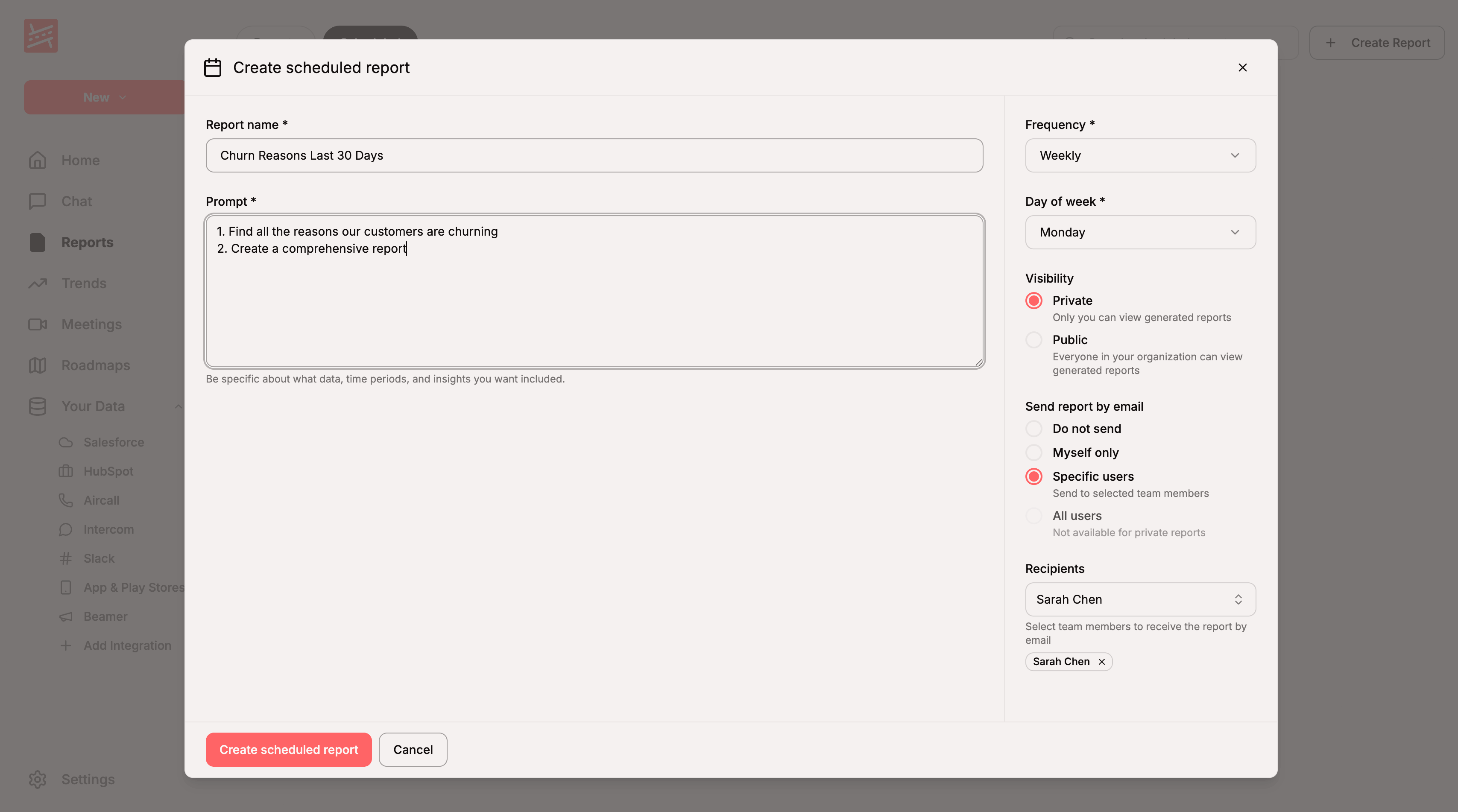
Create a scheduled report from the Reports page — give it a name and a prompt describing the question you want answered, pick a frequency and recipients, and Roadmappy AI will run it and email the results on your chosen cadence.
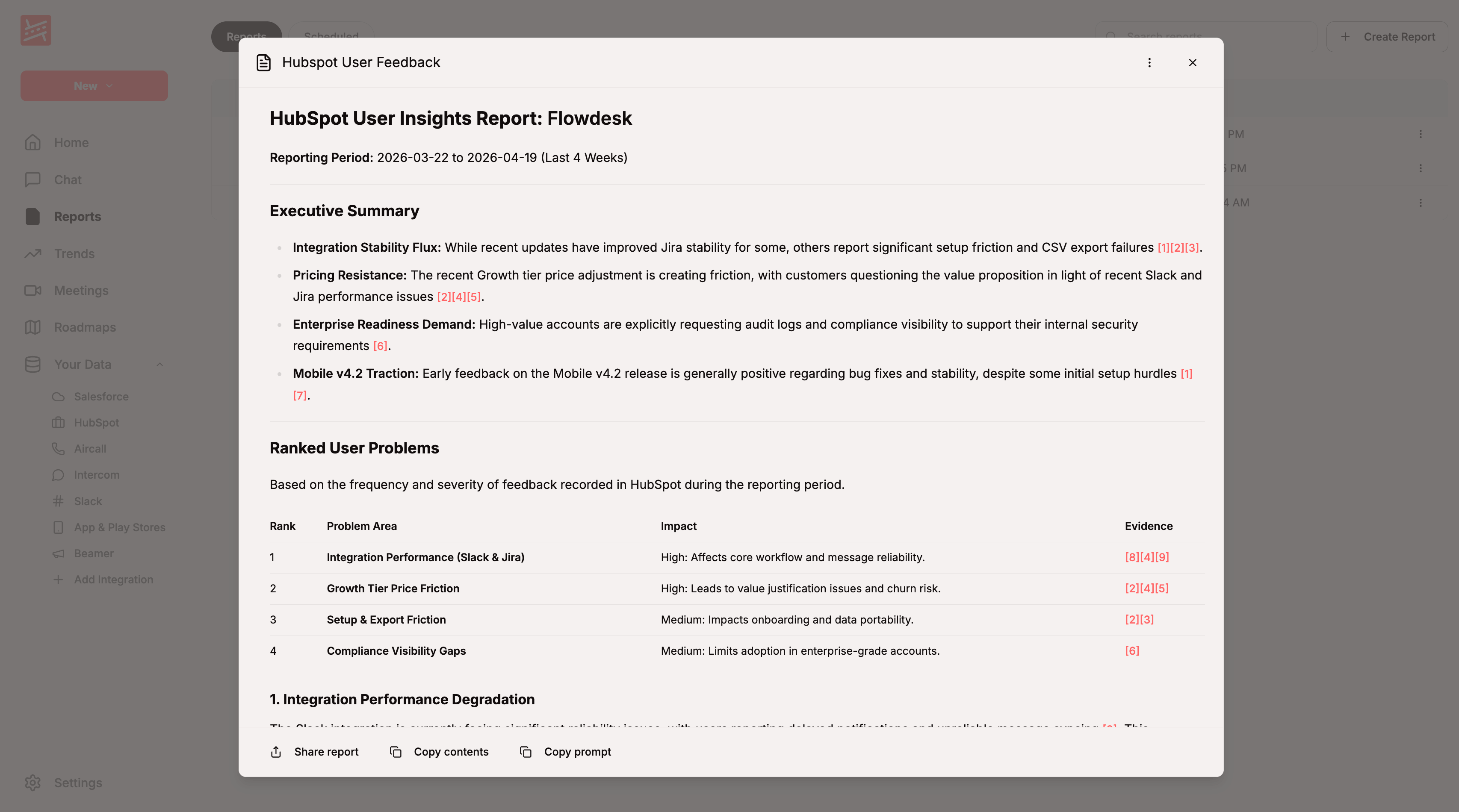
Open a report to see the full Roadmappy AI-authored summary. Every claim cites the exact HubSpot engagements and CRM records (alongside meetings and other sources) it drew from, so you can drill into the source material in one click.
Tags and Trends
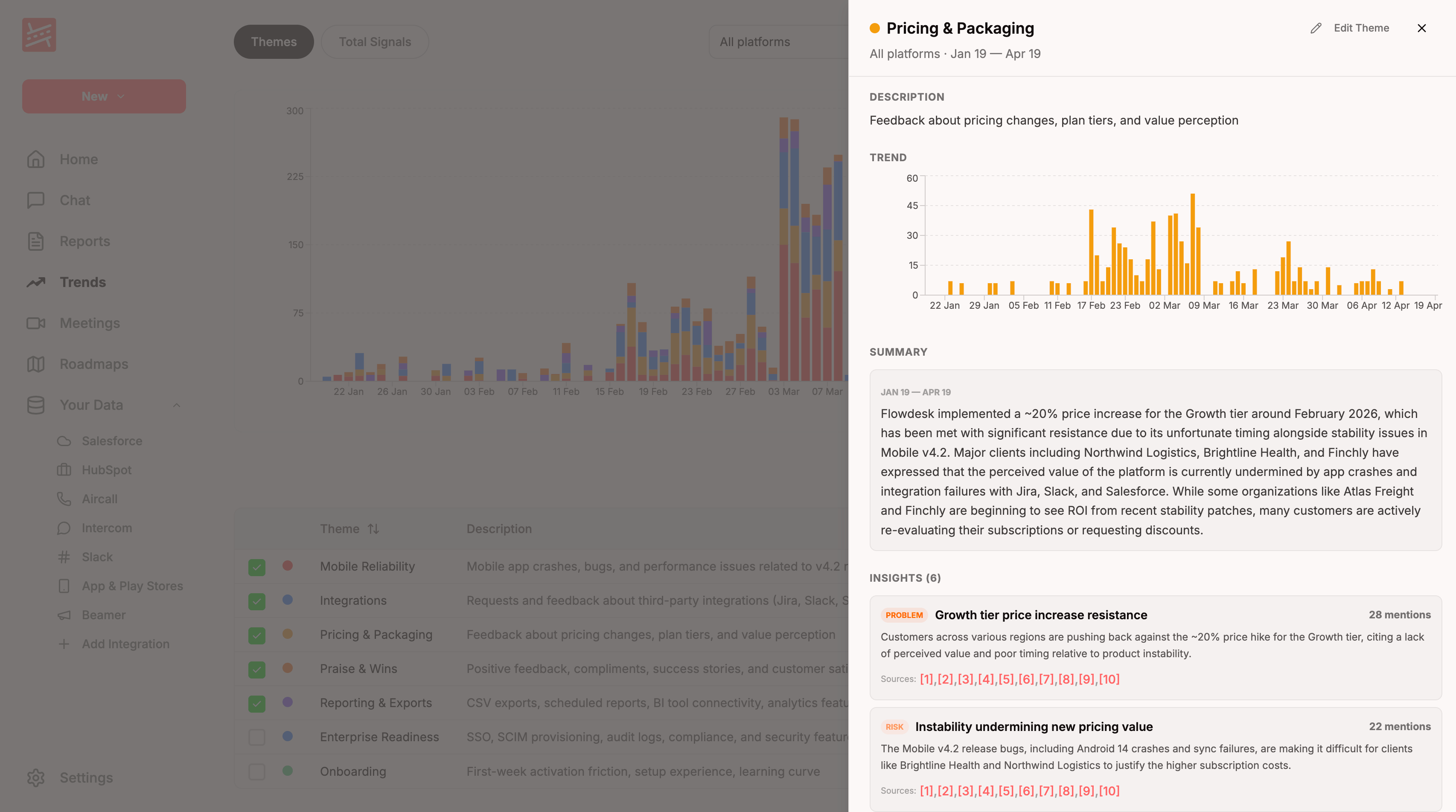
HubSpot engagements are automatically tagged by Roadmappy AI — themes like Pricing & Packaging, Mobile Reliability, or Integrations surface on each call, email, meeting, and note (visible in the engagement detail view above). From Trends, you can pick any theme to see how HubSpot feedback on it has moved over time, read the AI-written summary of what customers are saying, and drill straight into the insights that back it up.
Data freshness
After the initial backfill, Roadmappy runs incremental syncs on a schedule — only records modified in the last couple of days are fetched, keeping things efficient. You don't need to do anything to keep the data up to date.
Pausing the sync without deleting data
If you just want to stop HubSpot syncing for a while — without losing any of the data already ingested — open the HubSpot integration modal and flip the Status toggle off. Sync jobs pause immediately; flip the toggle back on to resume. Your contacts, companies, deals, tickets, engagements, tags, trends, and citations all stay in place while the integration is deactivated.
Deleting all HubSpot data
Only workspace admins can delete HubSpot data. The Delete flow is admin-gated both in the UI and in the API — editors and viewers see the Danger Zone but the input and button are disabled.
To permanently remove the HubSpot integration and every record Roadmappy has synced from it, scroll to the Danger zone at the bottom of the HubSpot integration modal, type
DELETE into the confirmation field, and click Delete all data and integration.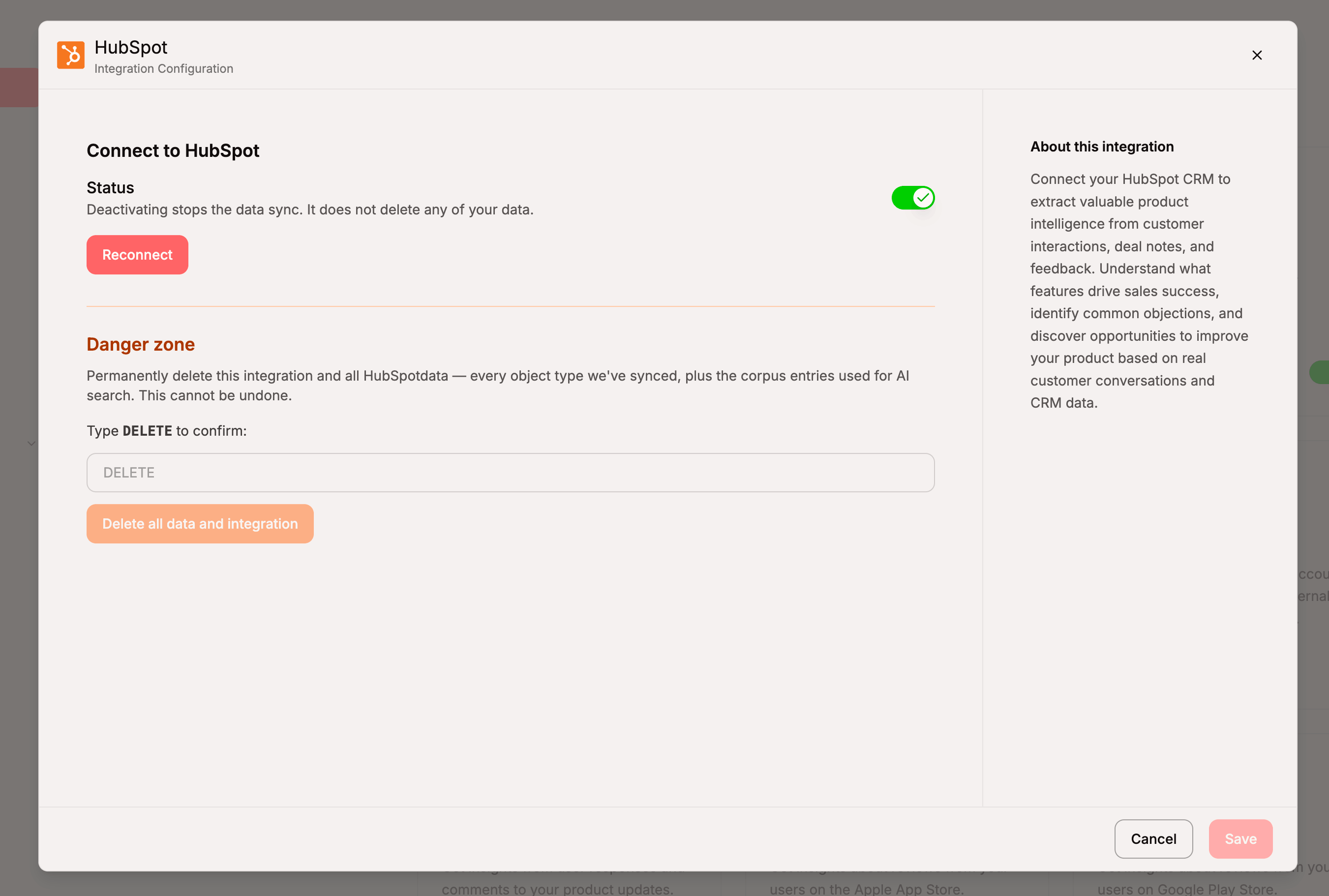
When you confirm, Roadmappy:
- Queues a background wipe for every HubSpot object type — contacts, companies, deals, tickets, owners, and engagements (calls, emails, meetings, notes).
- Deletes all corpus entries derived from HubSpot, so those citations disappear from AI Chat and Reports.
- Hard-deletes the integration record itself, so the HubSpot card on the Integrations page immediately shows as disconnected.
- Writes an audit row for each step — object type, deleted row count, and the admin who triggered the deletion — for compliance.
The UI updates right away; the background wipe of the synced tables and corpus finishes within a few minutes, depending on volume.
You can reconnect at any time, but the full backfill will run again from scratch.
Deletion is permanent
Deleting the integration removes all HubSpot-derived data from your Roadmappy workspace. Reports and chat answers that previously cited deleted records will lose those citations. There is no undo.
Troubleshooting
My HubSpot account isn't syncing
- Open Settings → Integrations and confirm the HubSpot card shows Connected with the Active toggle on.
- If the toggle is off, flip it on — syncs pause when the integration is deactivated.
- If the initial backfill has been running for more than a few hours on a large account, contact support and we can check the sync job directly.
I reconnected but new records aren't appearing
Reconnecting refreshes the OAuth token but does not re-run the backfill — it waits for the next scheduled incremental sync. If you need an immediate re-sync (for example, to re-ingest engagements from before the per-type backfill cap), reach out to support.
I connected the wrong HubSpot account
Click Reconnect in the HubSpot modal. This restarts the OAuth flow and lets you authorise a different HubSpot account, replacing the previous connection. Any records already synced from the old account will remain until you do a full delete.
Still have questions? Contact us at Contact us at support@roadmappy.io and we'll get back to you.